
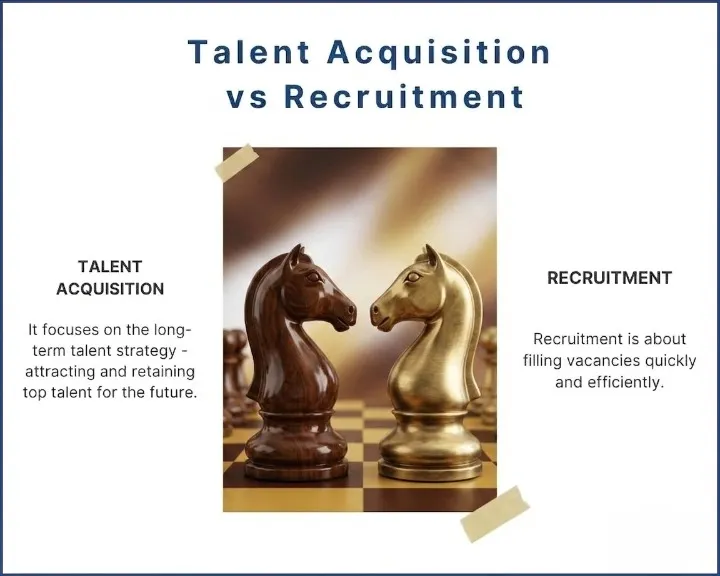
Talent Acquisition vs Recruitment Services: Every growing business eventually confronts the same fundamental tension in its approach to hiring: should the focus be on filling today’s open roles as quickly and efficiently as possible, or on building the talent strategy and pipeline that will power the organisation’s growth over the next two, three, or five years? The answer, for most competitive US businesses, is that both are necessary, but understanding the distinction between recruitment and talent acquisition, and knowing when to deploy each, is critical to building a workforce that drives sustained, scalable growth.
This guide provides a definitive examination of both Talent Acquisition vs Recruitment Services, their definitions, their differences, their respective strengths, and the circumstances in which each delivers the best outcomes. It also explains how All Talentz’s unique model combines both approaches to give US businesses the speed of responsive recruitment and the strategic power of long-term talent acquisition through a single, integrated partnership.
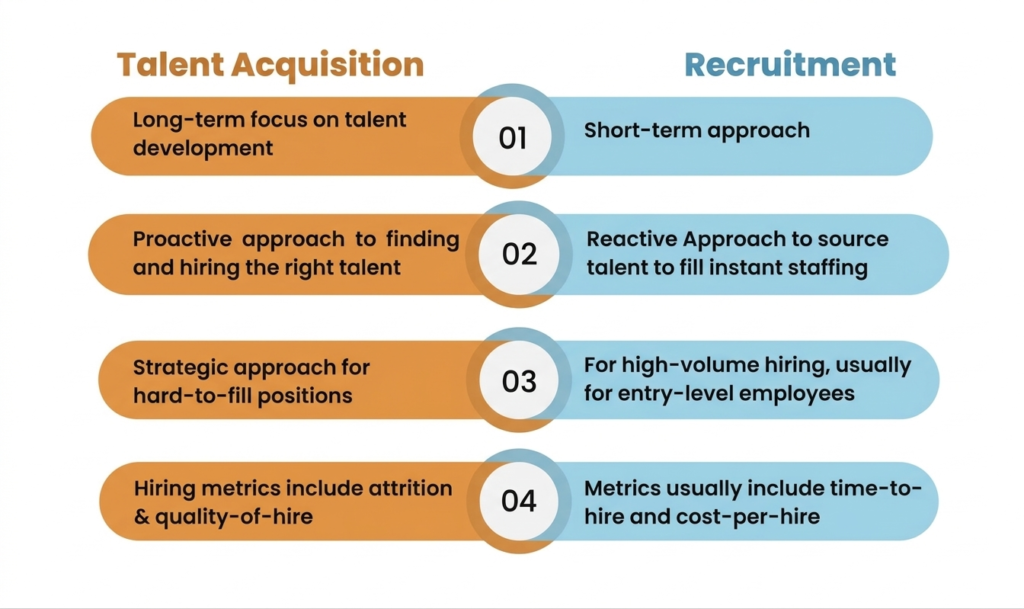
Talent Acquisition vs Recruitment: The Key Differences
What Is Recruitment?
Recruitment is the structured, operational process of identifying candidates and guiding them through a selection process to fill a specific, open vacancy. It is typically triggered by an existing gap, a departure, a new role created by business growth, or a project-specific staffing need, and is oriented toward speed and precision: finding the right candidate and placing them as efficiently as possible. Recruitment is inherently transactional and reactive; its success is measured by how quickly and accurately it fills the immediate opening.
In practice, recruitment involves job posting, candidate sourcing, application screening, interviewing, reference checking, offer management, and handover to onboarding. It is a linear process with a defined endpoint: the accepted offer. Once the vacancy is filled, the recruitment process for that role is complete until the next vacancy arises. Recruitment does not, by itself, build pipelines, develop employer reputation, or create strategic workforce advantage. It is an operational capability, not a strategic one.
What Is Talent Acquisition?
Talent acquisition is a fundamentally different discipline, broader in scope, longer in time horizon, and more strategic in orientation than recruitment. Where recruitment fills a vacancy, talent acquisition builds a workforce. Talent acquisition encompasses the full spectrum of activities involved in attracting, engaging, selecting, and retaining the professionals an organization needs to achieve its long-term strategic objectives, including many activities that take place long before a specific vacancy exists.
Key components of talent acquisition include employer brand development and management, workforce planning and skills forecasting, talent pipeline cultivation, relationships with universities and professional networks, data-driven hiring analytics, diversity and inclusion strategy, and long-term retention planning. Talent acquisition professionals think in terms of the organisation’s talent needs over 12, 24, and 36 months, anticipating requirements before they become urgent and building the pipelines that make future hiring faster, better, and more cost-effective.
Short-Term Hiring vs Long-Term Workforce Planning
The distinction between recruitment and talent acquisition can be summarised most simply as the difference between short-term and long-term thinking in workforce management. Recruitment addresses an immediate need, a specific vacancy that must be filled now. Talent acquisition addresses an ongoing strategic imperative, ensuring the organisation always has access to the quality and quantity of talent required to execute its strategy and grow its capabilities over time.
Companies that operate exclusively in recruitment mode are perpetually reactive. They hire in response to problems rather than in anticipation of opportunities, pay premium fees for urgent placements, and consistently underinvest in the employer brand and pipeline development that would make future hiring cheaper and faster. Companies with mature talent acquisition strategies hire less reactively, spend less per hire, fill roles more quickly, attract better candidates, and retain professionals longer because their people strategy is genuinely aligned with their business strategy.
| Key Distinction Recruitment asks: Who can fill this role now? Talent acquisition asks: What talent do we need to achieve our goals in 12, 24, and 36 months and how do we attract, develop, and retain them? Both questions matter. All Talentz helps US businesses answer both simultaneously. |
Which Approach Fits Modern Businesses?
Modern US businesses operating in competitive, fast-moving markets need both. Pure recruitment capability makes a business responsive but not strategic, always filling gaps but never building ahead of demand. A pure talent acquisition strategy without a responsive recruitment capability leaves businesses unable to address urgent vacancies quickly. The optimal approach integrates both: a strategic acquisition framework that builds pipelines and anticipates future needs, combined with efficient, high-quality recruitment execution that fills immediate vacancies rapidly without compromising quality or culture.
All Talentz is built precisely to deliver this integration. Our strategic advisory capability and pre-vetted talent pipeline enable forward-thinking workforce planning; our rapid placement process handles immediate hiring needs. Clients access both without managing two separate vendors or processes.
Recruitment Services in the USA
Current Recruitment Trends in the US
The US recruitment landscape in 2025 is shaped by several converging trends that are fundamentally changing how businesses find and hire talent. Artificial intelligence and machine learning are transforming candidate sourcing, screening, and matching, dramatically accelerating early stages of the recruitment process while raising questions about bias and the appropriate role of human judgment. Remote and hybrid work has permanently expanded the geographic scope of candidate searches, forcing recruiters to develop new capabilities for evaluating and engaging professionals who may never set foot in the office.
At the same time, persistent talent shortages in technology, healthcare, finance, legal services, and operations continue to drive intense competition for qualified candidates, pushing up compensation expectations, lengthening time-to-fill for specialised roles, and placing a premium on recruiters who can identify and engage high-quality candidates quickly. The businesses best positioned in this environment are those that have combined technology efficiency with human relationship capability, and that have embraced global talent markets to supplement a domestic labour supply that cannot fully meet demand.
Challenges Facing US Recruiters
US recruiters in 2026 navigate a genuinely difficult environment. The competition for top candidates in high-demand fields is fierce; qualified technology professionals, lawyers, financial analysts, and experienced operations managers receive multiple competitive offers simultaneously. This competition drives up time-to-fill, increases offer decline rates, and puts upward pressure on starting salaries that erodes business margins.
Beyond immediate competition, US recruiters grapple with structural challenges: an ageing workforce creating retirement-driven talent gaps; mismatches between the skills produced by domestic educational institutions and the technical requirements of fast-evolving business functions; and rising candidate expectations around flexibility, career development, and organizational culture. These structural challenges are not temporary; they reflect fundamental shifts in the US labor market that require strategic, not just tactical, responses.
The Real Cost of Getting To hire Wrong
Poor hiring decisions are among the most expensive mistakes a business can make, yet most organizations dramatically underestimate the true cost of a failed placement. The direct costs are visible: recruitment fees, onboarding investment, salary for a professional who does not work out, and the cost of replacing them. The indirect costs are less visible but far larger: lost productivity during the vacancy, management time consumed by performance management of a failing hire, team morale disruption caused by poor cultural fit, and the delay to business objectives that inadequate talent creates.
Research estimates that the total cost of a failed hire is typically 50–200% of annual salary, a figure that makes the investment in rigorous upfront screening and quality-focused talent acquisition an obvious and compelling business case. This is precisely why All Talentz’s thorough vetting process, which substantially reduces placement failure rates compared to unscreened alternatives, delivers far better value than the headline placement fee suggests.
The Demand for Remote Global Talent
The most powerful response to the structural challenges of the US domestic talent market is the adoption of global hiring practices, and demand for remote global talent among US businesses is growing rapidly. Businesses that were initially cautious about international remote hiring, concerned about communication quality or time zone management, have largely been won over by the evidence: well-managed remote teams consistently deliver exceptional results, and the talent quality available through global markets, particularly Africa, is genuinely competitive with domestic alternatives.
All Talentz sits at the center of this shift, providing US businesses with the infrastructure, expertise, and talent network required to make global remote hiring as straightforward and reliable as domestic hiring while delivering the high cost, quality, and scalability advantages that make it a compelling strategic choice.
How Outsourcing Recruitment Reduces Hiring Costs
Outsourcing recruitment to a specialist partner like All Talentz eliminates the hidden costs that make in-house recruitment far more expensive than most businesses realize. Direct costs, job board advertising, applicant tracking technology, recruiter salaries, and background check fees are visible. Indirect costs, such as management time reviewing applications and conducting interviews, productivity lost during vacancies, and the cost of poor hires, are less visible but often far larger.
All Talentz’s outsourced recruitment model addresses all of these costs simultaneously. Our pre-vetted talent pool eliminates the sourcing and initial screening burden. Our rigorous assessment process dramatically reduces the risk of poor hires. Our speed to placement minimizes the productivity cost of vacancies. And our transparent, value-based pricing consistently delivers cost-per-hire outcomes that outperform in-house alternatives by 30–50%, while improving placement quality.
Talent Acquisition in the USA
Strategic Hiring for Sustainable Growth
Strategic talent acquisition is one of the highest-leverage capabilities available to US business leaders. The quality and composition of an organization’s workforce determine its ability to execute its strategy, respond to market opportunities, innovate effectively, serve clients exceptionally, and grow sustainably. Businesses that invest in strategic talent acquisition, aligning hiring decisions explicitly with strategic objectives, build workforces that are purpose-designed for competitive advantage, not simply assembled from whoever was available when a vacancy arose.
In practical terms, this means starting every hiring decision with a clear understanding of what the business needs to achieve, not just what the job description says. It means hiring ahead of growth, not just in response to it. It means investing in the employer brand so that the best candidates want to join. And it means measuring hiring quality by long-term business outcomes, retention, performance, and contribution to strategic goals, not just by how quickly and cheaply vacancies were filled.
Employer Branding and Talent Retention
Employer brand is the reputation a business carries as a place to work, and in a global talent market, it matters more than ever. Candidates research employers extensively before applying, reading reviews, assessing values alignment, evaluating growth opportunities, and comparing compensation transparency. Businesses with strong employer brands fill roles more quickly, receive more qualified applications, and enjoy significantly higher offer acceptance rates than those that have neglected their employer reputation.
Talent retention is the other side of the same coin. Businesses that invest in their employer brand, delivering on promises made during recruitment, providing genuine career development, building positive cultures, and treating people with respect and transparency, retain their best professionals far longer. Since the cost of replacing a professional is typically 50–200% of annual salary, strong retention is one of the most powerful drivers of workforce cost efficiency available to US businesses.
Using Data and Analytics to Hire Smarter
Data-driven talent acquisition is transforming how the most competitive US businesses make hiring decisions. Rather than relying on intuition and anecdote, data-driven organizations analyze their successful placements to identify the predictive indicators of high performance, the qualifications, experience patterns, assessment scores, and interview signals that most reliably correlate with long-term success in specific roles. They use this analysis to refine their hiring criteria, improve their assessment tools, and systematically improve placement quality over time.
All Talentz incorporates this analytical discipline into our own vetting and matching process, continuously tracking the performance outcomes of our placements and using that data to refine our candidate assessment and client-matching methodology. The result is a placement process that improves in accuracy and quality over time, delivering increasingly strong outcomes as our understanding of success patterns in specific roles and client environments deepens.
Building a Strong Remote Workforce
Building a high-performing remote workforce requires intentional design. The physical proximity that organically facilitates communication, collaboration, and cultural alignment in an office environment does not exist in a remote setting, and its absence must be consciously compensated for through deliberate structural choices. Businesses that succeed with remote teams make explicit decisions about communication norms, meeting cadences, documentation practices, performance management frameworks, and the cultural values and behaviors they expect from everyone in the organization.
All Talentz guides US clients through this design process, drawing on our experience with hundreds of successful remote team builds across multiple industries. We advise on the communication architectures that keep remote teams aligned and engaged, the management practices that maintain accountability without micromanagement, the onboarding structures that integrate new remote hires quickly and effectively, and the recognition and development approaches that sustain motivation and performance over the long term.
Accessing Skilled African Remote Talent
For US businesses building remote workforces, Africa represents an opportunity of extraordinary scope and quality. The continent’s rapidly growing pool of English-speaking, university-educated professionals spans every major business discipline. The combination of technical competence, professional ambition, cultural adaptability, and competitive compensation rates makes African talent one of the most compelling workforce investments available to US employers today.
All Talentz has built the infrastructure, relationships, and expertise to make this opportunity consistently accessible. Our talent network across Nigeria, Ghana, Kenya, South Africa, and beyond represents the genuine top tier of Africa’s professional workforce, rigorously vetted, professionally developed, and matched to the specific requirements of US client businesses with precision and care.
Talent Acquisition vs Recruitment: Which Strategy Wins?
When Recruitment Is the Better Option
Recruitment is the appropriate primary tool when the business faces a specific, well-defined vacancy with an immediate operational impact; when the role is relatively standard, and the candidate profile is clear; when the business has limited HR bandwidth and needs a fast, straightforward solution; or when the position is temporary, project-based, or fixed-term. In these circumstances, speed and precision in execution matter most.
Recruitment also makes sense as the primary approach for entry-level and high-volume roles where the candidate pool is large, the role requirements are standardised, and the cost of a placement that does not work out is relatively low. In these contexts, the overhead of a fully strategic talent acquisition approach does not generate proportionate returns.
When Talent Acquisition Delivers Better Results
Talent acquisition delivers superior outcomes when the cost and impact of getting to hire wrong person is high. Senior, specialist, and leadership roles, where the right hire can transform the business and the wrong hire can damage it, warrant an approach that builds a thorough understanding of the ideal candidate profile, cultivates relationships with the best potential candidates over time, and evaluates finalists against strategic alignment criteria as well as technical competence.
Talent acquisition is also the right approach when a business is building a new team or department from scratch, entering a new market, or launching a new product line that requires distinctive capabilities, planning a significant scaling event, or seeking to improve long-term retention by ensuring every hire is genuinely aligned with the organisation’s culture and trajectory.
The Hidden Costs of Choosing the Wrong Approach
Businesses that rely exclusively on reactive recruitment pay a compounding cost over time, not just in higher per-hire fees, but in the accumulated opportunity cost of consistently slower, lower-quality hiring. Each urgent, reactive placement costs more than a pipeline-supported hire, takes longer than a relationship-based acquisition, and carries higher failure risk than a strategically assessed hire. Multiplied across dozens of hiring decisions per year, the difference between a reactive and a strategic hiring approach can represent hundreds of thousands of dollars in annual cost advantage for the organization that invests in talent acquisition.
Conversely, businesses that invest heavily in a long-term talent acquisition strategy without maintaining a responsive recruitment execution capability find themselves unable to move quickly when the situation requires urgency. The optimal combination, strategic foundation, and operational agility is what All Talentz provides.
Combining Recruitment and Talent Acquisition
The most effective hiring strategies do not choose between recruitment and talent acquisition; they integrate both into a coherent, complementary approach. Talent acquisition provides the strategic framework: the employer brand, the talent pipeline, the workforce plan, and the long-term thinking that makes every individual hire faster, cheaper, and more successful. Recruitment provides the operational execution: the structured process that moves individual candidates efficiently from application to placement within the talent acquisition framework.
All Talentz is uniquely positioned to deliver this integration. Our strategic talent acquisition capability, deep talent pipelines, employer brand guidance, workforce planning advisory, and data-driven hiring analytics, combined with our rapid, high-quality placement execution, give US clients the full value of both disciplines through a single, trusted partner.
| All Talentz Advantage: Unlike traditional recruitment agencies that focus solely on immediate placements, All Talentz combines strategic talent acquisition planning with rapid, high-quality recruitment execution, giving US clients the long-term workforce advantage of acquisition strategy and the operational speed of responsive recruitment, simultaneously. |
Why Modern Businesses Need Both Talent Acquisition and Recruitment Strategies
In today’s competitive environment, businesses that rely exclusively on reactive recruitment are strategically exposed. Without pipeline development and employer brand investment, every hiring need becomes an urgent, expensive crisis. Without strategic workforce planning, growing businesses find themselves perpetually behind on talent, hiring in response to capability gaps rather than ahead of strategic opportunity.
All Talentz makes both accessible, affordable, and effective for US businesses of every size, from startups making their first remote hires to mid-market companies building international teams at scale. Our comprehensive service model ensures every client gets the right balance of strategic and operational support for their specific stage of growth.
Why All Talentz Is the Right Hiring Partner
Access Trained and Vetted Professionals
The cornerstone of All Talentz’s value proposition is the quality of the talent we deliver. Every professional in our network has passed through our comprehensive multi-stage vetting process, which assesses technical competence, communication quality, professional reliability, cultural adaptability, and remote working capability. Clients receive curated shortlists of professionals who have already demonstrated the capability to deliver at the level required. This quality assurance is consistent, rigorous, and backed by our replacement guarantee.
Faster Hiring and Team Scaling
Speed without quality is not a value; it is a risk. All Talentz delivers both, simultaneously. Our pre-vetted talent pool enables rapid candidate presentation; our deep expertise in role and candidate assessment ensures that speed does not come at the expense of placement quality. For US businesses that need to move quickly, scaling a team to meet demand, backfilling a critical departure, or launching a new function, our combination of speed and quality is genuinely distinctive in the market.
Transparent Pricing and No Hidden Fees
One of the most common frustrations with recruitment agencies is the opacity of their pricing models, placement fees calculated on opaque percentages, hidden charges for additional services, and renegotiated terms once the client is engaged. All Talentz operates with complete pricing transparency. Our fee structures are clear, fair, and communicated upfront. There are no hidden charges, no surprise invoices, and no fee escalations as engagements progress. Clients know exactly what they are paying and exactly what they are receiving, which is the foundation of the trust that makes long-term partnerships possible.
Reduce Operational Costs
The cost savings delivered by All Talentz are substantial, consistent, and well-documented across our US client base. Total workforce cost reductions of 60–75% compared to domestic equivalents are standard. For businesses with multiple remote hires, these savings compound rapidly, freeing significant capital for reinvestment in growth, technology, and competitive positioning.
Improve Productivity With Remote Teams
Well-managed remote teams consistently match or outperform their in-office counterparts across virtually every productivity metric. All Talentz professionals are selected precisely for the attributes that determine remote working success: strong asynchronous communication, disciplined self-management, digital tool proficiency, and a results-oriented professional approach. When combined with All Talentz’s onboarding support and ongoing client guidance, these professionals deliver focused, accountable, high-quality output that drives real business results.
Choosing the Right Hiring Strategy for Your Business
The choice between talent acquisition and recruitment is not binary; it is a question of balance, timing, and strategic alignment. Businesses that fill today’s vacancies efficiently while building tomorrow’s talent pipeline are those that grow fastest, hire best, and retain most effectively. All Talentz gives US businesses the tools, expertise, and talent network to do exactly that, combining the operational speed of responsive recruitment with the strategic power of long-term talent acquisition.
Whether your immediate need is a single, high-quality remote hire or a comprehensive talent strategy for scaling your entire workforce, All Talentz has the capability, the commitment, and the track record to deliver. Stop choosing between speed and quality, between tactical and strategic, between cost efficiency and talent excellence. With All Talentz, you get all of it, and you get it now.
Ready to Transform Your Hiring Strategy? Partner With All Talentz
Frequently Asked Questions About Talent Acquisition vs Recruitment
Acquisition vs Recruitment Services: Recruitment is a reactive, role-specific process focused on filling an immediate vacancy efficiently. Talent acquisition is a proactive, strategic discipline that encompasses workforce planning, employer brand development, talent pipeline cultivation, and long-term hiring strategy. Recruitment solves today’s problem; talent acquisition builds tomorrow’s workforce advantage. Most competitive US businesses need both, which is precisely what All Talentz delivers.
Acquisition vs Recruitment Services: Talent acquisition delivers stronger long-term business growth outcomes by ensuring the organization always has access to the talent required to execute its strategy. It reduces cost-per-hire over time, improves retention, strengthens employer brand, and prevents the costly reactive hiring cycles that constrain growth. However, talent acquisition works best when supported by responsive recruitment execution, the combination that All Talentz provides.
Acquisition vs Recruitment Services: Talent acquisition strategy is particularly powerful in remote hiring contexts because it enables proactive global pipeline building, identifying and cultivating relationships with qualified remote professionals before vacancies arise. This dramatically reduces time-to-fill for remote roles, improves placement quality, and ensures global hiring decisions are strategically aligned with long-term workforce needs rather than simply driven by immediate urgency.
Acquisition vs Recruitment Services: US businesses outsource recruitment to reduce cost-per-hire, accelerate time-to-placement, access specialist global talent expertise, and eliminate the administrative and management burden of running recruitment in-house. For businesses without dedicated HR functions, outsourcing to All Talentz provides professional-grade recruitment and talent acquisition capability at a fraction of the cost of building it internally.
Absolutely, and in many ways, small businesses benefit most from strategic talent acquisition because they have the least margin for hiring mistakes. Every hire at a small business significantly impacts team culture, capability, and performance. All Talentz provides affordable talent acquisition support scaled to the budgets and operational realities of small and growing businesses.
Acquisition vs Recruitment Services: Technology, financial services, legal services, healthcare administration, marketing, e-commerce, and professional services are among the heaviest users of strategic talent acquisition. However, any industry with high talent competition, specialised skill requirements, or significant cost-of-hire failure stands to benefit substantially.
Acquisition vs Recruitment Services: All Talentz provides comprehensive talent acquisition and recruitment support, from workforce planning and role scoping to candidate sourcing, multi-stage vetting, placement, onboarding support, and ongoing workforce management. We specialize in connecting US businesses with the highest-quality African remote professionals, delivering exceptional talent at 40–70% lower total cost than equivalent domestic hires.
Acquisition vs Recruitment Services: Highly so. US businesses hiring through All Talentz consistently achieve total talent cost reductions of 60–75% compared to equivalent domestic hires. For roles in technology, legal support, finance, and operations, where domestic compensation expectations are highest, the savings can be transformative, releasing capital for reinvestment in growth and competitive positioning.