

Medical coding is far more than a back-office function. It is the clinical-to-financial translation layer that determines whether your practice is paid accurately, compliantly, and on time. A single miscoded procedure can trigger a payer audit, generate a claim denial, expose your practice to False Claims Act liability, or simply leave thousands of dollars permanently unreimbursed.
For healthcare organizations across the United States, the question is no longer whether to work with medical coding outsourcing companies; it is how to choose the right one. In 2025, the medical coding outsourcing market is projected to exceed $22 billion globally, driven by mounting coder shortages, ICD-10-CM annual updates, and the increasing complexity of value-based care coding requirements.
This guide delivers a comprehensive comparison framework to help hospitals, physician groups, FQHCs, and specialty practices evaluate medical coding outsourcing companies with precision and confidence.
The U.S. Medical Coding Landscape: Why Outsourcing Has Become a Strategic Necessity
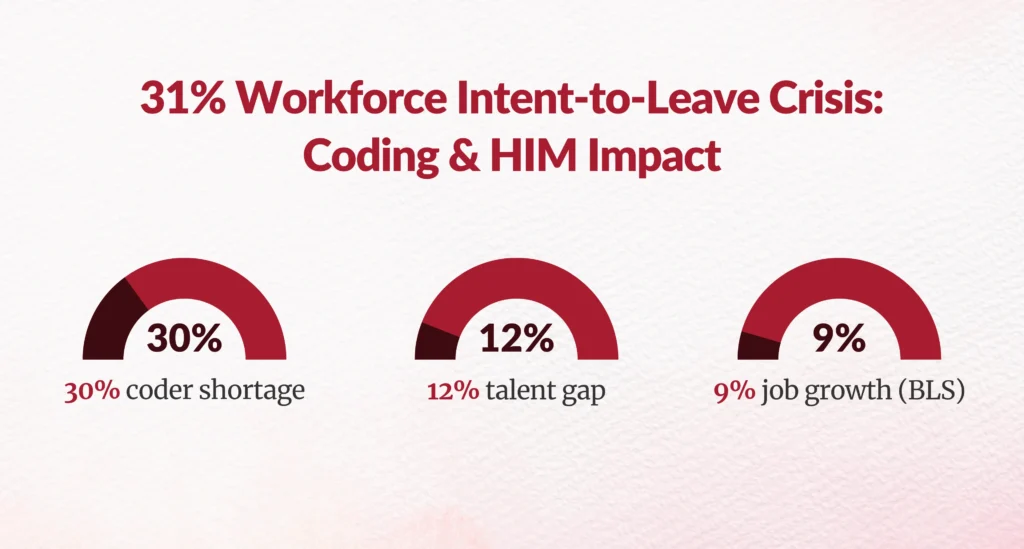
The American Health Information Management Association (AHIMA) estimates that the U.S. healthcare system faces a shortfall of between 10,000 and 15,000 qualified medical coders. Meanwhile, the complexity of the coding environment continues to expand:
- ICD-10-CM contains over 72,000 diagnosis codes, with CMS adding or revising hundreds of codes in each fiscal year update
- CPT code updates occur annually, with significant revisions to E/M coding guidelines that affect nearly every specialty
- HCC (Hierarchical Condition Category) coding for Medicare Advantage patients requires detailed risk adjustment expertise that many in-house teams lack
- CMS’s shift toward value-based reimbursement models, including MIPS, APMs, and bundled payments — demands a higher level of coding precision than traditional fee-for-service
The consequences of poor coding are severe. The Office of Inspector General (OIG) reported that improper Medicare payments reached $31 billion in fiscal year 2023, with a significant portion attributable to coding errors. Healthcare organizations caught in coding audits face repayment demands, civil monetary penalties, and in serious cases, exclusion from Medicare and Medicaid p
In-House Coding vs. Outsourced Coding: A Direct Comparison
Before evaluating vendors, it is important to honestly assess the performance gap between in-house coding operations and a high-quality outsourcing partner.
| Metric | In-House Coding (Industry Avg.) | All Talentz Outsourced Coding |
|---|---|---|
| Coding Accuracy Rate | 60–70% | 99%+ |
| Average Turnaround Time | 3–5 days | 24–48 hours |
| Cost per Chart | $6–$12 | Flexible, typically lower |
| Coder Certification | Variable | CPC/CCS/RHIA certified |
| ICD-10 Annual Update Readiness | Delayed 30–60 days | Day-one compliance |
| HCC/Risk Adjustment Expertise | Limited | Specialty teams available |
| Audit Support | Internal only | External audit defense included |
| Scalability | Hiring-dependent | On-demand scaling |
How to Evaluate Medical Coding Outsourcing Companies: 8 Critical Criteria
The comparison above illustrates the performance differential, but choosing the right vendor requires a more granular evaluation. Here are the eight criteria that matter most.
1. Coder Credentials and Certification Requirements
Only consider vendors that employ coders with active, recognized certifications. The gold-standard credentials for medical coders include:
- CPC (Certified Professional Coder): issued by AAPC, the most widely recognized outpatient coding credential
- CCS (Certified Coding Specialist): issued by AHIMA, with a strong emphasis on inpatient and facility coding
- RHIA/RHIT (Registered Health Information Administrator/Technician): broader HIM credential with coding expertise
- CRC (Certified Risk Adjustment Coder): critical for practices with significant Medicare Advantage volume
At All Talentz, all coders hold active credentials and are required to complete annual continuing education units (CEUs) to maintain certification through each ICD-10-CM and CPT update cycle.
2. Specialty Coding Depth
Medical coding is not a generalist skill. Orthopedic surgery coding requires mastery of fracture care modifiers, arthroplasty bundling rules, and post-operative global period management. Behavioral health coding involves complex session-based E/M codes, psychotherapy add-on codes, and payer-specific carve-out rules. Oncology coding encompasses chemotherapy administration sequences, drug J-codes, and radiation therapy planning codes.
When evaluating vendors, ask for documentation of their coder specialization by practice type and request references from clients in your specific specialty. Generalist coders applied to specialist billing is one of the most common and costly mistakes in outsourcing selection.
3. Accuracy Rate Guarantees and QA Process
Any credible coding outsourcing company should be able to quote you their coding accuracy rate, defined as the percentage of coded charts that require no correction after internal QA review. The industry benchmark is 95%; best-in-class vendors target 98–99%.
Ask specifically how accuracy is measured: Who performs the QA audits? How frequently? What happens when a coder’s accuracy falls below threshold? Is there a secondary review process for high-complexity charts? These questions will quickly distinguish operationally mature vendors from those making unsupported claims.
4. Turnaround Time and Capacity Guarantees
Coding backlogs directly delay claims submission, which delays cash flow. Establish clear turnaround time (TAT) expectations in your service agreement. Standard TAT expectations for different care settings include:
- Outpatient physician coding: 24–48 hours from charge submission
- Inpatient facility coding: 48–72 hours from discharge
- Emergency medicine coding: Same-day or next-day processing
- Surgical coding: 24–48 hours from operative note completion
All Talentz maintains dedicated capacity pools for surge volume management, ensuring TAT commitments are met even during high-volume periods such as Q4 year-end or post-holiday rushes.
5. CDI Integration and Query Process
Clinical Documentation Improvement (CDI) and medical coding are deeply interrelated. A coding vendor that can identify documentation gaps and submit physician queries, in compliance with AHIMA query guidelines, adds significant revenue recovery value beyond basic coding services. Ask prospective vendors whether they offer CDI query services and how their query process integrates with your physician workflow.
6. Compliance Framework and Audit Support
The OIG’s annual Work Plan identifies coding compliance priorities that payers and auditors focus on each year. A qualified coding partner stays current with OIG guidance, CMS transmittals, and payer-specific local coverage determinations (LCDs). They should also provide proactive audit support, meaning if your practice receives a payer audit or RAC request, your coding vendor should provide documentation support and coding defense.
7. Technology Integration
Coding workflows must integrate with your EHR, encoder software, and billing system. Leading coders use encoder software such as 3M CodeFinder, Optum360 EncoderPro, or TruCode to ensure code accuracy and compliance. Ask how the vendor’s workflow connects to your existing systems and whether they support direct API integration or require workarounds.
8. Scalability and Flexibility
One of the most underrated advantages of outsourced coding is elastic scalability. As your practice grows, whether through new provider hires, expanded service lines, or additional locations, your coding capacity should scale without the lag of recruiting and training new hires. Confirm that your vendor can accommodate ramp-up within a defined timeframe and that their pricing scales fairly with volume.
HCC Coding: The High-Stakes Subspecialty That Demands Outsourcing Excellence
For practices with significant Medicare Advantage (MA) patient populations, Hierarchical Condition Category (HCC) coding has enormous financial implications. MA plans pay capitated rates to health plans based on the relative health risk of their enrolled members — a risk score derived from HCC codes submitted by providers. Undercoded HCC conditions result in risk score underestimation, which means practices receive lower capitated payments and plans lose accuracy in their population health programs.
A 2022 analysis by the Medicare Payment Advisory Commission found that risk score adjustments for Medicare Advantage resulted in aggregate overpayments exceeding $9.5 billion — largely attributable to both inappropriate upcoding and widespread undercoding that created pressure on the system. Getting HCC coding right is both a financial and a compliance imperative.
All Talentz maintains a dedicated HCC coding team with CRC-certified coders who specialize in annual wellness visits, chronic disease suspect identification, and retrospective chart reviews designed to ensure complete and accurate risk adjustment coding.
The All Talentz Medical Coding Outsourcing: Experience Quality, Speed, and Compliance at Scale
All Talentz was built on the principle that medical coding is too important to treat as a commodity. Every chart coded by our team goes through a structured quality workflow:
- Coder Assignment: Charts are routed to specialty-certified coders based on procedure type, payer, and complexity level.
- Primary Coding: The coder reviews the clinical documentation, applies appropriate ICD-10-CM, CPT, and HCPCS Level II codes, and flags any documentation gaps for CDI query.
- Secondary QA Review: High-complexity charts and a randomized sample of standard charts undergo secondary review by a senior coder or QA analyst.
- Compliance Screening: All codes are screened against OIG high-risk code lists, National Correct Coding Initiative (NCCI) edits, and payer-specific LCD policies.
- Submission to Billing: Approved coding is transmitted to the billing workflow for claim scrubbing and submission within agreed TAT windows.
The result: a coding accuracy rate consistently above 98%, a denial rate attributable to coding errors below 1.5%, and turnaround times that consistently beat industry benchmarks.
Your coding accuracy is directly tied to your revenue. Find out how All Talentz can audit your current coding performance and identify missed revenue opportunities.
Frequently Asked Questions About Medical Coding Outsourcing Companies:
Medical coding is the process of translating clinical documentation, diagnoses, procedures, services, into standardized alphanumeric codes (ICD-10-CM, CPT, HCPCS). Medical billing involves submitting those coded claims to payers, following up on unpaid claims, and collecting payment. Coding feeds billing: errors in coding create downstream billing problems.
Key indicators of coding underperformance include denial rates above 5% specifically attributed to coding errors, clinical documentation improvement (CDI) queries going unanswered, rising AR days, coding accuracy rates below 95% on internal audits, or coders who are not current with the most recent ICD-10-CM and CPT annual updates.
Key indicators of coding underperformance include: denial rates above 5% specifically attributed to coding errors, clinical documentation improvement (CDI) queries going unanswered, rising AR days, coding accuracy rates below 95% on internal audits, or coders who are not current with the most recent ICD-10-CM and CPT annual updates.
Key indicators of coding underperformance include denial rates above 5% specifically attributed to coding errors, clinical documentation improvement (CDI) queries going unanswered, rising AR days, coding accuracy rates below 95% on internal audits, or coders who are not current with the most recent ICD-10-CM and CPT annual updates.
They are required to be. Every medical coding outsourcing company you work with must sign a Business Associate Agreement (BAA) and demonstrate documented HIPAA compliance, including secure data transmission, access controls, and workforce training. All Talentz maintains full HIPAA certification and executes BAAs with every client.
Quality vendors like All Talentz maintain dedicated overflow coding capacity for surge management. This ensures that your TAT commitments are met during high-volume periods, such as after holidays, at year-end, or following significant patient census increases, without compromising accuracy.
Most established vendors support integration with major EHR platforms. Alltalentz integrates with Epic, Cerner, athenahealth, eClinicalWorks, Meditech, and others. During onboarding, our team conducts a full workflow analysis to configure the cleanest possible data exchange between your clinical documentation and our coding workflow.
All Talentz provides specialty-specific coding for a wide range of disciplines, including emergency medicine, hospitalist medicine, orthopedic surgery, cardiology, neurology, behavioral health, oncology, physical and occupational therapy, podiatry, ophthalmology, and more. Each specialty has dedicated coders with verified expertise.
When done correctly, outsourcing reduces compliance risk. A qualified vendor brings dedicated compliance expertise, stays current with OIG guidance, NCCI edits, and payer LCDs, and provides audit-ready documentation for every coded chart. All Talentz also offers proactive compliance reporting and supports clients through payer audits.
Expect an initial coding baseline audit to establish your current accuracy rate, a workflow configuration period to align systems, a parallel coding phase where both your team and the vendor code the same charts to validate accuracy, and progressive handover of coding responsibility. All Talentz provides a structured 90-day onboarding roadmap for every new client.