

Medical billing is the financial backbone of every healthcare practice in the United States. Yet for thousands of clinics, hospitals, and specialty providers, it is also one of the most persistent sources of inefficiency, lost revenue, and administrative burnout. According to the American Medical Association, physician practices spend an average of $99,000 per physician per year on billing and insurance-related administrative costs, a figure that has been climbing steadily for over a decade.
Partnering with medical billing outsourcing companies has become a strategic imperative for healthcare organizations looking to reduce overhead, recover more revenue, and keep their clinical staff focused on patient care. But not all outsourcing vendors are created equal. Choosing the wrong partner can mean delayed payments, compliance violations, and deteriorating payer relationships.
This guide breaks down exactly what to look for when evaluating medical billing outsourcing companies, what questions to ask, and how All Talentz helps healthcare providers across the U.S. achieve measurable financial performance improvements.
Why U.S. Healthcare Providers Are Outsourcing Medical Billing
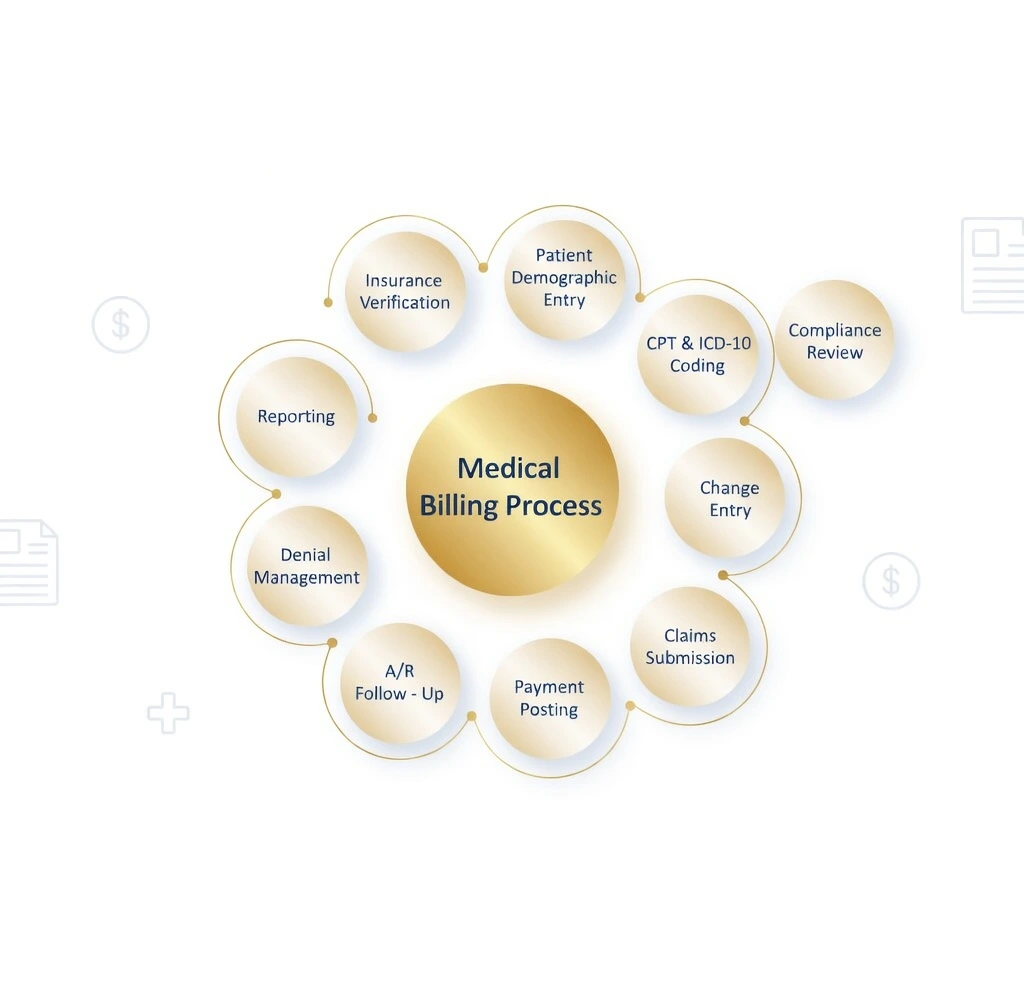
The U.S. healthcare billing environment is uniquely complex. With over 7,000 active CPT codes, hundreds of insurance payers, evolving ICD-10-CM guidelines, and constant regulatory updates from CMS, maintaining a fully competent in-house billing team is both expensive and demanding.
Here are the primary reasons healthcare organizations are turning to outsourced billing partners:
- Staffing challenges: The U.S. faces a significant shortage of certified medical billing professionals. High turnover in billing departments leads to knowledge gaps, slower claims cycles, and increased denial rates.
- Rising claim denial rates: The Medical Group Management Association (MGMA) reports that the average claim denial rate in the U.S. is approximately 5–10%, with some specialties experiencing rates as high as 15–20%. Each denial costs a practice between $25 and $117 to rework.
- Regulatory complexity: Compliance with HIPAA, CMS guidelines, payer-specific requirements, and No Surprises Act provisions requires continuous training and oversight.
- Technology investment: Maintaining modern billing software, clearinghouse integrations, and analytics tools in-house requires significant capital expenditure.
- Revenue leakage: Studies suggest that healthcare practices lose up to 3–5% of their annual revenue due to billing errors, undercoding, and missed charge capture.
What to Look for in a Medical Billing Outsourcing Company
Selecting a billing partner is a consequential business decision. The right company becomes an extension of your practice, deeply integrated into your workflows, accountable to your financial performance, and aligned with your compliance obligations. Below are the most critical evaluation criteria.
1. Specialty-Specific Experience
Not all billing companies have depth across all medical specialties. A company that excels at primary care billing may lack the nuanced expertise required for orthopedic surgery, behavioral health, oncology, or interventional pain management. Before engaging any vendor, ask for documented experience and client references within your specific specialty.
All Talentz serves a wide range of specialties, including internal medicine, cardiology, physical therapy, urgent care, and behavioral health, with dedicated billing teams who understand specialty-specific payer rules, modifier requirements, and authorization workflows.
2. First-Pass Claim Rate and Denial Management
The single most telling performance metric for any billing company is its first pass claim acceptance rate, the percentage of claims accepted by payers on the first submission without revision. Industry best practice is 95% or higher. Ask any prospective vendor for their average first-pass rate, broken down by payer type.
Equally important is denial management. Even the best billers face denials; what matters is how fast and how effectively those denials are worked. Look for a partner that has a structured denial workflow, tracks denial reasons by category, and provides monthly reports on denial resolution rates.
3. HIPAA Compliance and Data Security
Any company handling protected health information (PHI) must be fully HIPAA-compliant. This includes signed Business Associate Agreements (BAAs), encrypted data transmission, role-based access controls, and documented incident response protocols. Ask for their most recent HIPAA risk assessment and ask whether they conduct regular staff training on data privacy.
4. Technology Stack and EHR Integration
Your billing partner should integrate seamlessly with your existing electronic health record (EHR) and practice management system. The best medical billing outsourcing companies support integration with leading platforms, including Epic, Cerner, athenahealth, eClinicalWorks, Kareo, and DrChrono, among others. Manual data re-entry between systems is a major source of billing errors and delays.
5. Transparent Reporting and Analytics
You should never have to wonder how your practice is performing financially. Top-tier billing partners provide dashboards and monthly reports covering gross and net collection rates, days in accounts receivable (AR), denial rates by payer and code, aging AR buckets, and charge capture versus collections ratios. If a vendor is reluctant to provide granular reporting, that is a significant red flag.
6. Pricing Structure
Most medical billing outsourcing companies charge a percentage of monthly collections, typically between 3% and 8%, depending on specialty and volume. Some charge flat monthly fees. Understand exactly what is included in the fee: Does it cover denial rework? Patient statement processing? Credentialing support? Make sure you understand the contract terms, minimum volume requirements, and exit clauses before signing.
Common Red Flags When Evaluating Billing Vendors

Not every outsourcing company will serve your practice well. Watch for these warning signs:
- No documented first-pass claim rate or vague performance claims
- Inability to provide a signed BAA before contract execution
- Lack of dedicated account managers, you’re just a ticket number
- No EHR integration requires manual data transfer
- Offshore-only operations with no U.S.-based oversight or compliance team
- No references from practices in your specialty
- Contracts with automatic renewal clauses and steep exit penalties
The Real Cost of Staying In-House
Many practice administrators underestimate the true total cost of managing billing internally. When you factor in:
- Salary and benefits for billing staff ($45,000–$65,000+ per FTE annually)
- Ongoing training, coding certifications, and CEU requirements
- Billing software licensing and clearinghouse fees
- Lost productivity from billing staff turnover
- Revenue lost to uncollected claims, undercoding, and aging AR
…the cost of in-house billing often exceeds what a quality outsourcing partner would charge.
A 2023 study published in Health Affairs found that administrative costs in U.S. physician practices account for approximately 34% of total spending, with billing and insurance-related functions representing the largest share. Outsourcing these functions can reduce administrative overhead by 20–30% on average.
How All Talentz Stands Apart from Other Medical Billing Outsourcing Companies
All Talentz was built specifically to serve the needs of U.S. healthcare providers navigating a complex, payer-driven revenue environment. Here is what distinguishes All Talentz from the crowded field of billing vendors:
- Dedicated specialty teams: Each client is assigned a billing team with proven experience in their specific specialty.
- 99%+ first-pass claim acceptance: Our rigorous pre-submission claim scrubbing process catches errors before they become denials.
- End-to-end revenue cycle management: From charge capture to payment posting and patient collections, we manage your entire billing workflow.
- Real-time performance dashboards: Log in anytime to view your practice’s financial KPIs, broken down by payer, provider, location, and procedure.
- Proactive denial management: Denials are worked within 48 hours, with root cause analysis provided monthly.
- HIPAA-certified compliance: All staff are trained and certified, BAAs are executed on day one, and data security is audited quarterly.
- U.S.-based account management: Every All Talentz client has a named account manager based in the United States for seamless communication.
Ready to stop losing revenue to billing inefficiencies? Schedule a meeting with All Talentz today. Our experts will audit your current billing performance and show you exactly where revenue is being left on the table.
Frequently Asked Questions About Medical Billing Outsourcing Companies in the U.S
Medical billing outsourcing companies manage the entire process of submitting claims to insurance payers and collecting payment on behalf of healthcare providers. This typically includes charge capture review, medical coding audit, claim scrubbing and submission, ERA and EOB posting, denial management, patient statement generation, and AR follow-up.
Most billing companies charge between 3% and 8% of monthly collected revenue, depending on specialty, volume, and scope of services. Some vendors offer flat monthly fees. At All Talentz, we provide custom pricing based on your practice’s specific needs and volume. Our fees are always transparent with no hidden charges.
No, in fact, most practices gain more visibility into their billing performance after outsourcing. All Talentz provides real-time dashboards and monthly performance reviews, giving you more insight into your revenue cycle than most in-house teams can deliver.
A typical onboarding and transition takes between 2 and 6 weeks, depending on EHR complexity, payer credentialing status, and data migration requirements. All Talentz has a structured onboarding protocol designed to minimize disruption to your cash flow during the transition period.
It should be, and verifying this is your responsibility as the covered entity. Any billing company you work with must sign a Business Associate Agreement (BAA) and demonstrate HIPAA-compliant data handling practices. All Talentz is fully HIPAA-certified and executes a BAA before any data is shared.
Yes. All Talentz specializes in supporting multi-provider and multi-location practices. Our systems are designed to handle complex organizational structures with separate billing configurations, cost centers, and reporting requirements for each location or provider.
All Talentz conducts a thorough AR aging analysis during onboarding. We work outstanding claims from your previous billing period and can recover significant revenue from aging AR that may have been abandoned by your prior vendor or in-house team.
Key warning signs include: net collection rate below 90%, days in AR above 40, denial rates above 8%, growing aging AR buckets, lack of regular performance reporting, or declining monthly revenue without a corresponding drop in patient volume. Contact All Talentz for a free revenue cycle benchmarking assessment.




The point about specialty-specific experience really stands out—billing nuances can vary so much between fields, and a generic approach often leads to avoidable denials. I’d also add that ongoing communication and responsiveness from the outsourcing partner can make a huge difference in catching issues early. Curious how often practices should realistically review performance metrics with their billing vendors to stay on track.
The breakdown of key factors like specialty-specific experience and first-pass claim rate really highlights why choosing the right outsourcing partner matters so much. It’s easy to overlook the impact of poor denial management or lack of EHR integration, but as the post points out, these issues can lead to significant revenue loss and operational inefficiencies. Thanks for the practical insights on what to look for when evaluating vendors.