

Running a business in the United States in 2026 requires a level of strategic clarity that was not necessary five years ago. Global instability — from geopolitical tensions in the Middle East and Eastern Europe to ongoing trade disruptions and inflationary pressure — is creating real, measurable uncertainty for US businesses of every size. Supply chains remain volatile. Hiring costs are elevated. Margins are tighter than most leadership teams would like.
And yet, some companies are not just surviving this environment. They are growing through it.
The difference is not luck, and it is not a larger budget. It is a deliberate, strategic approach to how US businesses cut costs during economic uncertainty — one that protects quality, maintains output, and positions the business to accelerate when conditions improve.
Understanding how US businesses cut costs effectively starts with separating structural changes from short-term fixes. Freezing a budget or delaying a hire is a short-term fix. Restructuring how work gets done is a structural change — and structural changes are what create lasting competitive advantage.
According to recent US labor market data, hiring costs in specialized roles have continued to climb even as broader employment conditions fluctuate. For business owners and operations leaders, this reinforces the urgency of building a smarter cost structure — not just managing expenses, but rethinking how the business is staffed and operated from the ground up.
This guide breaks down five of the most effective strategies smart US companies are deploying right now, and explains exactly how to put each one into practice.
Why Economic Uncertainty Is Hitting US Businesses Harder in 2026
Before getting into solutions, it is worth being direct about the scale of the pressure. The economic environment US businesses are operating in right now is the product of several converging forces — not any single event.
Persistent inflation has kept operating costs elevated even as the Federal Reserve attempted to bring them under control. The global ripple effects of ongoing conflicts — particularly disruptions to energy markets and international supply chains — have made input costs unpredictable. Tariff uncertainty has complicated procurement for businesses with international suppliers. A tighter labor market in specialized fields has pushed hiring costs in key sectors to levels that are difficult to sustain.
For business owners and operations leaders, the result is a familiar but uncomfortable equation: pressure to reduce costs while maintaining the quality and capability that customers expect.
Knowing how US businesses cut costs in ways that do not compromise output is the central leadership challenge of 2026. The World Economic Forum’s Future of Jobs Report identifies workforce restructuring and operational flexibility as the defining competitive variables for businesses navigating this environment — not technology alone, and not cost-cutting alone, but the intelligent combination of both.
5 Proven Strategies: How US Businesses Cut Costs Without Cutting Growth
Here are the five strategies that are working right now — across industries, company sizes, and operational models.
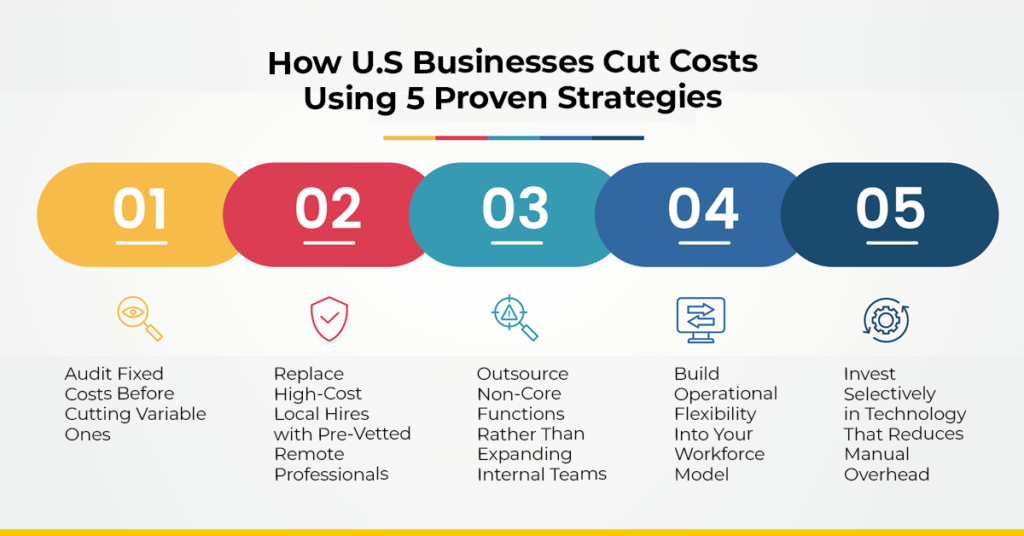
1. Audit Fixed Costs Before Cutting Variable Ones
The instinct during economic uncertainty is to reduce variable costs first — freeze hiring, cut travel, reduce marketing spend. But the businesses that come out ahead are typically the ones that conduct a thorough fixed cost audit before touching variable spending.
Fixed costs — office leases, legacy software subscriptions, underutilized vendor contracts, and bloated benefit structures — are often significantly more expensive than they need to be. A structured audit of fixed obligations typically reveals 10–20% in immediately recoverable savings without affecting operational output.
The practical starting point is a line-by-line review of every recurring expense over $500 per month. For each one, ask three questions: Is this delivering current value? Is there a more cost-effective alternative? Can this be renegotiated given current market conditions?
2. Replace High-Cost Local Hires with Pre-Vetted Remote Professionals
This is where US businesses are finding the most significant and durable savings. Remote work infrastructure is now mature enough that the performance difference between a local hire and a well-managed remote professional in a comparable role is negligible for most functions.
This is one of the most impactful ways how US businesses cut costs without reducing output — and it compounds over time. The cost difference is substantial. Businesses that partner with managed remote staffing companies are saving between 50–75% on fully-loaded labor costs for roles in finance, administration, claims support, technology, legal services, and customer operations — without reducing the quality of output.
The key word is managed. The approach that works is not offshoring to the lowest bidder on a freelance platform. It is working with a structured staffing partner that pre-vets candidates, handles compliance and payroll, provides performance oversight, and actively manages the engagement. All Talentz was built specifically to deliver this model — giving US businesses access to high-quality remote talent with the accountability structure of a full-service employment relationship.
For a business currently spending $80,000 per year on a finance or operations role, a managed remote equivalent typically costs $25,000–$40,000. That delta — $40,000–$55,000 per role per year — is one of the most powerful answers to how US businesses cut costs while maintaining capability.
3. Outsource Non-Core Functions Rather Than Expanding Internal Teams
One of the clearest patterns among businesses that manage cost well during uncertainty is a disciplined distinction between core and non-core functions. Core functions are the activities that directly generate competitive advantage. Everything else is a candidate for outsourcing.
Medical billing, data entry, IT helpdesk, payroll administration, claims processing, legal research — these are functions where quality and consistency matter, but where having an in-house team is not a strategic necessity. To understand what business process outsourcing involves and how it works in practice, the process is simpler than most business owners expect — and the cost savings are immediate.
Outsourcing these functions to specialist providers reduces fixed headcount, eliminates benefits overhead, and typically improves quality through specialist expertise. The misconception that outsourcing means sacrificing control has been largely disproven by the maturation of managed outsourcing models.
4. Build Operational Flexibility Into Your Workforce Model
One of the most expensive things a business can do during economic uncertainty is carry a fixed headcount that cannot flex with demand. When revenue dips, fixed payroll becomes an existential pressure. When demand surges, the inability to scale quickly means missed revenue.
The businesses that manage uncertainty best have deliberately built flexibility into their workforce model — a core of permanent employees supplemented by a managed remote layer that can scale up or down as conditions change. This is one of the structural answers to how US businesses cut costs during volatile periods without making permanent reductions they later regret.
It is now possible to add a trained, pre-vetted remote professional in a specific function within days rather than weeks, and to scale back just as quickly if conditions require it. For US businesses facing demand volatility, this flexibility is worth more than any individual cost saving.
5. Invest Selectively in Technology That Reduces Manual Overhead
Economic uncertainty is not a reason to freeze technology investment — it is a reason to be selective about which technology investments pay back fastest. The category with the most consistent near-term return is automation of high-volume manual tasks: document processing, reporting, scheduling, invoice management, and data reconciliation.
Businesses that invest in task automation during downturns typically emerge with structurally lower cost bases than competitors who froze all discretionary spending. The combination of task automation and managed remote staffing is particularly powerful — automation handles the repetitive high-volume tasks; trained remote professionals handle the judgment-intensive work that requires human decision-making. Together, they deliver a cost structure that in-house teams of equivalent size cannot match.
What the Businesses Getting This Right Have in Common
Across industries — insurance, healthcare, finance, technology, and legal services — the US businesses that are managing economic uncertainty most effectively share a few consistent characteristics.
They made structural changes, not just tactical cuts. They did not simply freeze budgets or defer hires. They restructured how work gets done, who does it, and what it costs — in ways that will remain advantageous long after the current uncertainty passes.
They moved fast when conditions were clear. The businesses that waited for certainty before acting on remote staffing or outsourcing paid for that delay through lost savings and missed momentum. The ones that acted decisively when the opportunity was clear built competitive advantages that are now difficult for slower-moving competitors to close.
They understood that how US businesses cut costs effectively is not a one-time decision — it is an ongoing operational discipline. The businesses that treat it that way are consistently outperforming those that address cost only when there is a crisis.
A Practical Framework for US Business Leaders
If you are a business owner or operations leader working through how US businesses cut costs during economic uncertainty, here is a practical sequence to follow:
1. Conduct a fixed cost audit this week. List every recurring expense over $500 per month. Flag anything that is not actively delivering value. This alone typically uncovers significant immediate savings.
2. Identify three to five roles in your business that could be performed by a managed remote professional. Focus on roles where the output is measurable, the work is digital, and physical presence is not required. Finance, administration, data, legal support, and claims functions are strong starting points.
3. Get a cost comparison. Take the fully-loaded annual cost of one of those roles — salary, benefits, payroll taxes, office overhead — and compare it to a managed remote equivalent. The gap is almost always larger than expected.
4. Start with one role. A single managed remote hire that performs well builds the internal confidence and the operational template to expand the model. Starting with the highest-cost, most measurable role makes the ROI easy to track.
5. Review your non-core functions. List every function your team performs that is not directly tied to your competitive advantage. For each one, ask whether an external specialist could deliver the same or better output at lower cost.
The Businesses That Will Lead After the Uncertainty Clears
Economic uncertainty is temporary. The structural changes businesses make during it are not.
Every significant economic disruption over the past 30 years has produced the same pattern: companies that used the period of pressure to restructure their operations and reduce their cost base emerged with durable advantages that lasted years beyond the disruption itself. Companies that treated it as a temporary inconvenience to be waited out found themselves competing against leaner, more flexible rivals when conditions improved.
The framework above reflects how US businesses cut costs in a way that creates lasting competitive advantage — not just temporary relief. Remote staffing, managed outsourcing, and operational automation are not emergency measures. They are permanent structural improvements that make your business more profitable, more scalable, and more resilient regardless of what the economic environment looks like next year.
The question of how US businesses cut costs while maintaining quality is no longer theoretical. The model exists, it works, and the businesses using it right now are the ones that will be positioned to grow fastest when conditions improve.
Ready to Start Reducing Costs Without Reducing Quality?
All Talentz helps US businesses across insurance, healthcare, finance, legal, and technology build managed remote teams that deliver real output at a fraction of the cost of local hiring. Our professionals are pre-vetted, trained in your industry, and fully managed — so you get the cost saving without the management overhead.
If you are ready to build a leaner, more resilient operation, we are ready to show you exactly what that looks like for your specific business.