

Hiring the wrong person is expensive. A bad hire costs a business an average of 30% of that employee’s first-year salary in wasted recruitment time, onboarding effort, and lost productivity. And yet most businesses still rely on the same slow, unpredictable hiring process; posting a job, sifting through hundreds of applications, interviewing, and hoping for the best.
If you are looking to hire remote talent without all of that friction, there is a better way. This post walks you through what pre-vetted remote hiring actually looks like, why it outperforms traditional recruitment, and how All Talentz takes the headache out of the entire process.
The Real Cost of Getting Hiring Wrong
Before we talk about how to hire remote talent the right way, it is worth understanding what the wrong approach is costing you.
Traditional hiring is slow. The average time to fill a role is 42 days. It is expensive; factor in job board fees, recruiter commissions, hours of internal review time, and a signing bonus if needed. And it is risky without a proper vetting process, you are making a significant financial commitment based on a CV and a few conversations.
Now multiply that by every department that is understaffed or overwhelmed. The cost is not just financial. It is the time your leadership team spends managing a bad hire instead of driving growth.
What Does Pre-Vetted Actually Mean?
The phrase ‘pre-vetted’ gets used loosely in the hiring industry. Here is what it should mean, and what it means at All Talentz specifically.
A genuinely pre-vetted remote professional has been assessed for skills, verified for experience, tested for communication ability, screened for reliability, and confirmed to have the technical setup needed to work remotely at a professional standard. That process happens before you ever see their name.
At All Talentz, pre-vetting is not a checkbox. It is a multi-stage process that includes skills assessments, background checks, communication evaluations, and a trial period before placement. When you hire remote talent through us, you are choosing from a shortlist of people we have already put through that process, not the full unfiltered pool.
Why Businesses Are Moving Away from Job Boards
Job boards work for some things. But when you need to hire remote talent at a consistent quality level, they create more problems than they solve.
• You get volume, not quality. Hundreds of applications means hundreds of hours of screening.
• You have no way to verify what candidates claim on their CVs without doing your own vetting.
• Freelancer platforms give you individuals with no accountability structure — if they disappear, you start over.
• There is no ongoing management support. Once you hire, you are fully responsible for performance, compliance, and payroll.
The businesses that get the most from remote hiring are the ones that treat it as a managed service, not a one-time transaction. That shift in thinking is what separates companies that scale well from those that keep repeating the same hiring mistakes.
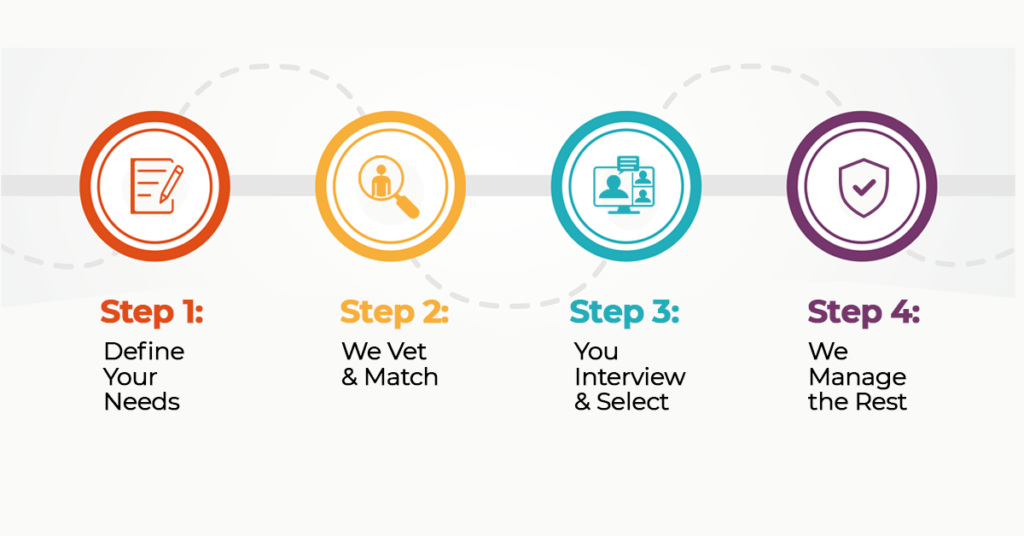
How to Hire Remote Talent the Right Way: A Step-by-Step Guide
Whether you work with All Talentz or build your own remote hiring process, these are the steps that separate successful remote teams from frustrating ones.
Step 1: Define the Role With Precision
The biggest reason remote hires fail is a poorly defined role. Before you hire remote talent, write out exactly what the person will do every day, what tools they need to use, what output you will measure them on, and what success looks like at 30, 60, and 90 days. Vague job descriptions attract vague candidates.
Step 2: Prioritize Managed Vetting Over Volume
Resist the urge to post everywhere and see who applies. Instead, work with a partner who has already done the vetting. When you hire remote talent through a managed staffing model, your time goes into reviewing a small, qualified shortlist, not hundreds of unscreened applications.
Step 3: Test for Remote Readiness, Not Just Skills
A candidate can be excellent at their job and still struggle in a remote environment. Look for indicators of self-management, communication clarity, and comfort with async work. Ask candidates to complete a short task as part of the process. How they handle it tells you more than their CV.
Step 4: Onboard With the Same Rigor as a Local Hire
One of the most common mistakes businesses make when they hire remote talent for the first time is assuming remote professionals need less onboarding. They need the same structure – clear expectations, regular check-ins, defined communication channels, and a proper introduction to how your business operates.
Step 5: Use a Partner Who Owns the Back-End
Payroll, compliance, performance management, tax documentation — these functions belong in the hands of your outsourcing partner, not on your plate. When you hire remote talent through All Talentz, we handle all of that. Your job is to direct the work. Our job is to manage everything else.
What Roles Can You Hire Remote Talent For?
The short answer is: more than you think. All Talentz places managed remote professionals across four specialist verticals:
• IT and Tech: Developers, QA engineers, IT support specialists, systems administrators
• Healthcare: Medical billing specialists, healthcare administrators, patient coordinators, coding professionals
• Finance: Bookkeepers, accounts managers, financial analysts, payroll administrators
• Legal: Paralegals, legal researchers, contract reviewers, legal administrative assistants
Each vertical is staffed by professionals who understand the domain, not generalist VAs taking on specialist work. That distinction matters when accuracy, compliance, and expertise are non-negotiable.
How Much Does It Cost to Hire Remote Talent Through All Talentz?
The cost varies depending on the role, seniority level, and scope of work. What does not vary is the saving. Businesses that hire remote talent through All Talentz save up to 75% compared to the equivalent local hire in the US or UK. For most clients, that saving funds multiple additional hires, turning one budgeted position into a full remote team.
There are no recruitment fees, no placement charges, and no surprise invoices. Our model is straightforward: you get the talent, we manage everything behind it, and you pay a clear, predictable rate.
The Difference Between Hiring a Freelancer and Hiring Managed Remote Talent
This distinction matters and it is worth being clear about it.
A freelancer is self-employed, self-managed, and self-accountable. When you hire remote talent through a managed staffing model, you get a professional who has a management structure behind them — performance oversight, quality checks, and an escalation path if something goes wrong. The accountability sits with the staffing partner, not entirely with you.
For businesses that want reliable output without the overhead of managing every individual directly, the managed model is not a luxury. It is a necessity.
Ready to Hire Remote Talent That Actually Delivers?
All Talentz makes it straightforward to hire remote talent across Tech, Healthcare, Finance, Restoration & Remediation, and Legal. Our professionals are pre-vetted, fully managed, and ready to integrate into your team from day one. You focus on growing your business. We handle the rest.
Stop losing time to bad hires and slow recruitment cycles. Tell us what you need and we will show you exactly who is available and what they can do for your business.




Comments 4